
Login or Subscribe
You must be logged in to access this content
Subscribe for free access to Japanese Exotic Mushroom Journal and gain insider knowledge on effective cultivation methods for Japanese mushroom species. Elevate your skills with expert tips and innovative technologies to master the art of growing Japanese exotic mushrooms.
◆ Discover exclusive Japanese mushroom cultivation techniques
◆ Learn innovative methods to enhance mushroom quality and yield
◆ Tap into Japan's rich heritage for unique growing insights
◆ Discover exclusive Japanese mushroom cultivation techniques
◆ Learn innovative methods to enhance mushroom quality and yield
◆ Tap into Japan's rich heritage for unique growing insights
Subscribe Now for Free Login
The future of mushroom growing?
Lessons from Japan`s highly developed frontline
Oscar Wrenn, Chief Editor
- Japan`s present; the world`s future?Working with Japanese mushroom farmers and farm suppliers, it is sometimes easy to take for granted just how remarkable the industry is here; I am often reminded of this when growers come to visit from abroad, and marvel at the high yields, the lack of contamination, and the excellent quality and control, all achieved without what appears (on the surface) to be a large expenditure of effort. What is now a given, however, was the result of over half a century of research and refinement, as bottle (originally spent glass milk bottles) and then bag technology was developed to grow a wide range of increasingly high-yielding and stable saprophytic fungi.Japan`s position as a pioneer in mushroom farming has never been in doubt, and has now produced a mature industry that is dominated by highly standardised and intensified production, alongside high consumption (usually in a set number of dishes commonly consumed in Japan, such as winter hotpot and miso soup). Japan`s yearly production of mushrooms (almost entirely `exotic` species) now hovers around 435,000 tons per year (MAFF 2025), coming only behind China, with the average household consuming almost 10kg (MAFF 2021) of mushrooms every year. From their initial position as a `fruit of the forest`, mushrooms have done what they do best, and entangled themselves into the lives of others; in this case, the Japanese population.
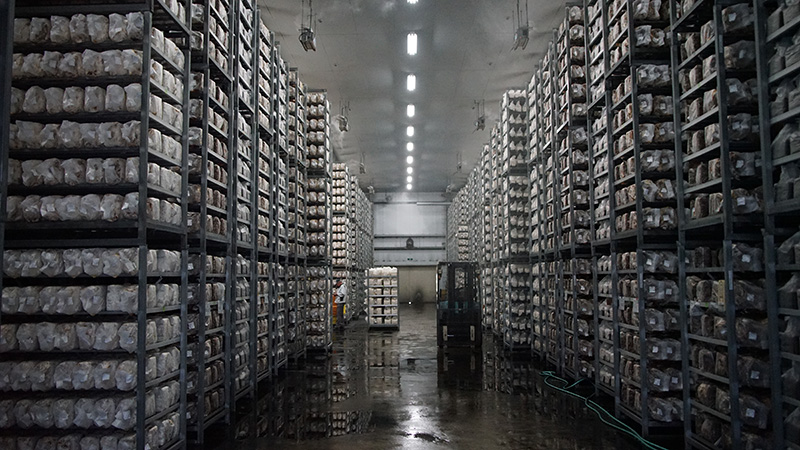
- An example of the scale and precision by which most modern Japanese farms operate, the result of over half a century of research and development.
- As a result of this continual development and refinement, however, have come difficulties, as Japan shows the limits of this approach. Prices for mushrooms have fallen steadily since the 1990s, and now are seen as a `cheap staple`, purchasable anywhere in the country for staggeringly low prices and very rarely as a luxury good (at least for mushrooms produced on blocks/bottles; foraged matsutake fetch eye-watering prices in season). For producers this has led to incredibly tight bottom lines, affected particularly by increases in energy costs and the price of sawdust and other inputs; the result has been a race to the bottom with cost-cutting measures taken wherever possible in terms of automation to reduce labour costs, new cheaper sources of substrate (as in the wholesale move over from sawdust to corn cob meal for enoki production), and new strains to increase harvest quantity per bottle/bag. This all while maintaining the high quality of product expected by the Japanese consumer, and with a shrinking population that means little prospect of increased demand in the future.For farmers outside of Japan (and China), these may seem like distant issues, irrelevant in markets where automation for exotics (both bottle and bag systems) still has plenty of room to develop, the `hierarchy` of mushroom demand is still unstable, and overall consumption is rising. It is worth, however, thinking about what can be learned from the Japan experience: what has gone (extremely) well in terms of technological development and expertise; and where there might be pitfalls to avoid. Japan might seem like it is living in the future, but the mushroom industry in other parts of the world might be there sooner than we think.
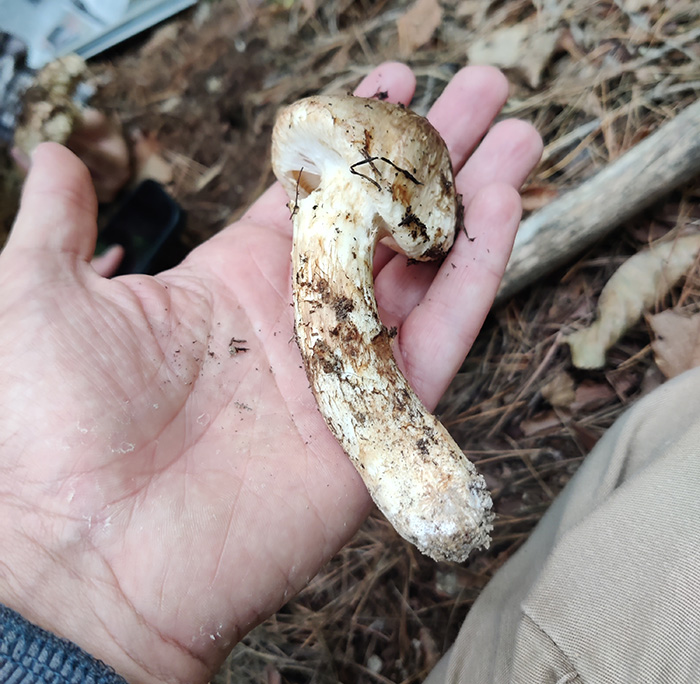
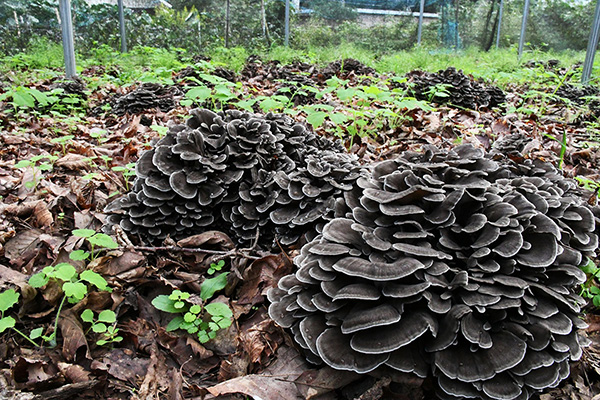 Most mushrooms in Japan are incredibly cheap to purchase; the one exception is the sought-after matsutake.Maitake growing in the forest. Masuno argues for a more diverse mushroom industry in Japan that better mimics the genetic diversity found within wild species.
- Diversity within developmentI had the opportunity to think about the direction of mushroom growing, in Japan as well as abroad, when reading a newly released book here in Japan that gives an insider`s perspective on the domestic mushroom industry: where it has come from, and what might need to change. Authored by Masuno Kazuhiko, a researcher who for the majority of his career was based at public research institutes in Nagano prefecture, From the Forest to Your Table: Delicious and Fun Smallscale Cultivation in the Forest and at Home is a response to the crisis of the industry, and the seeming `dead end` of a single-minded focus on intensification and standardisation. Noting the disappearance of small- and medium-sized producers - priced out by larger enterprises that have achieved highly efficient operations with stable, high yields - he describes a precarious situation for growers in Japan: high competition for an increasingly narrow selection of species, developed specifically to gain the highest yield in the shortest time.This precariousness is something that I often hear from mushroom growers in Japan, keen to automate and cut costs, but at the same time wary about the risks of going too far, constructing a highly efficient system that works beautifully in a very narrow set of circumstances, but inflexible to changes outside of their control, for example in the market. It is not unusual, for example, to hear stories of growers investing in harvesting machines that work with only one weight of mushroom, only to find that consumer demand requires something else entirely, leaving a `white elephant` behind. There is an inherent instability in highly managed, technologically-precise growing systems that can achieve remarkable efficiency, but are less good at adaptation.Masuno Kazuhiko`s answer to Japan`s precarious mushroom situation is a more diversified industry, able to maintain a balance between highly efficient growers, alongside those that focus more on quality, and specifically on a wide array of mushroom qualities that will appeal to different consumer tastes. He argues this is, after all, the basic state of mushrooms in their original environment: having a diversity of traits within a species is advantageous within a natural environment that is liable to change.
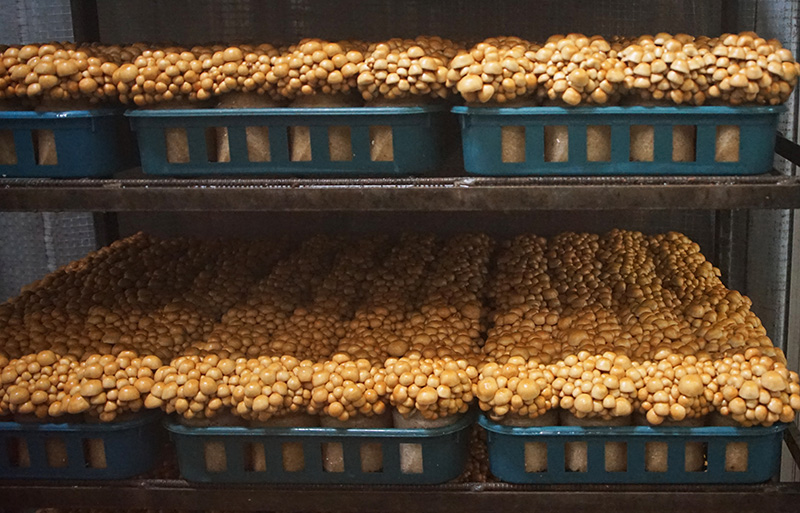
- Nameko production in Japan is now highly efficient, with very short incubation times and high yields from relatively small bottles. Is there space for an alternative nameko market alongside these efficient producers?
- The most delicious nameko, scientifically proven!Masuno gives an example of how this focus on diversity over intensity might be achieved, through his involvement in the development of a `more delicious` nameko strain. The history of nameko production in Japan has followed the trend of other major species: a large increase in production with automation and the development of efficient strains, demand failing to keep pace, meaning a slow fall or stagnation in prices over the past 30 years. What if, however, this trend could be stopped, or even reversed, by expanding consumption and demand based on deliciousness, and without a `race to the bottom`?On the surface, selecting for a new strain of nameko based on `taste` over harvest quantity or incubation time might seem like a lost cause, give the inherent subjectivity involved; taste, after all, is a complex result of various factors, including intangible ones such as memory, environment, culture, and so on. Masuno`s team, however, focused on the material factors they could measure, as a means of approaching an objective analysis of taste using a `taste sensor`. This device makes use of an artificial lipid membrane to analyse the interaction between the taste material and the membrane, to distinguish between salty, sour, bitter, astringent, and umami, as well as initial taste and aftertaste. Using this system, Masuno and his team set up a baseline for what could be considered a `delicious` nameko fruiting body, using a freshly harvested wild nameko which was widely regarded by foragers to be a fine specimen, and then taking measurements using the taste sensor as a baseline for `delicious`, notably low in bitterness and off tastes, and with strong umami. Using this, they were not only able to analyse a wide variety of different nameko strains to work out which best matched this `delicious` baseline, but also to examine how different parts of the transport and storage process preserved (or degraded) flavour away from the baseline.Masuno does not go into detail into how such research could be practically incorporated into a more diverse mushroom industry, but we can perhaps imagine how it might lead to the development of lower-yielding strains that can fetch a higher price as premium varieties, marketed on their culinary qualities, and likely with a stronger link between a producer and their local market (whether individuals, restaurants, or other buyers). Ultimately, this is one method of giving the industry a bit of `breathing room`: expanding the definition of what a mushroom is (what value it has, how it can be used, who can consume it), and allowing for a wider range of producers to find a niche and make a living, even amongst a backdrop of generally falling demand.
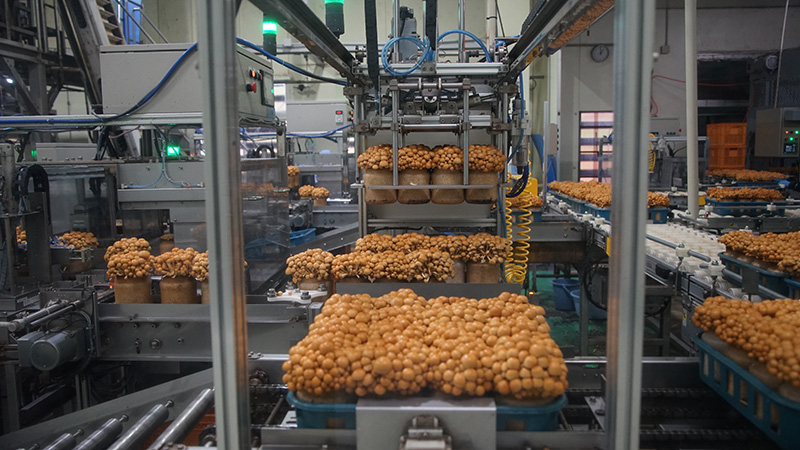
- The introduction of machinery to automate steps in the growing process - like these nameko harvesting machines - have allowed for much more efficient and cost-effective production. Many producers, however, still talk about the need for maintaining flexibility alongside this control and efficiency.
- Thinking aheadOf course, changing broad attitudes towards consumer goods with an eye to expanding consumption is no easy task, especially when it comes to mushrooms. This is evident in both Japan, through the many campaigns that have tried to change the image of mushrooms as a cheap staple, and abroad, with suspicion cast towards any mushroom that deviates two far from the archetypal Agaricus baseline.The advantage that growers (and others in the supply chain) outside of Japan have, is that the concept of what a non-Agaricus mushroom is still has plenty of room to be shaped. Interest and demand for `exotic` mushrooms is growing, and there is still a broad landscape of small- and medium-size growers looking for the way forward. While a quantitatively derived `delicious` mushroom might not be the right choice, there are plenty of other ways in which breathing space could be maintained: in, for example, mushrooms grown specifically for different consumer groups, drawing on vegan and vegetarian movements; developing mushroom strains and brands with specific types of dishes in mind; or directly linking mushroom growing with sustainable production, through emphasising where substrate is sourced and where it ends up post-cultivation. The rapid growth of `functional` mushroom products - whether as tablets, tinctures, or sold raw/dried - is one way in which this `breathing room` is already taking root, as specific qualities of specific species become selling points (see this issue`s article on lion`s mane supplements for an example of how this is being used in Japan).More than anything, there seems to be a need for maintaining flexibility, so as not to get tied into fragile production systems that are liable to be upturned. Medium-size growers in Japan are aware that there are many elements in the growing and selling process that are out of their control, not only prices and labour costs/availability, but also climate (a concern even in indoor cultivation), and the proclivities of the fungi itself (I have heard producers argue that while hygiene is important, too much control over environmental conditions post-inoculation can also lead to rapid changes in how the fungi behaves). Maintaining space for producers that can find niches in the market without focusing entirely on efficiency will no doubt involve thinking about the balance between better control, and flexibility.In this way Japan, and its numerous producers and researchers (many of whom have been dedicating their lives to mushrooms for multiple decades), offers plenty of hints about what the future holds for mushroom growing around the world, both what works well, and what might be avoided. All of it is worth paying attention to as the exotic sector expands.


 1-2-13 Honmachi, Komoro city, Nagano prefecture, Japan 384-0026